
Quick Answer
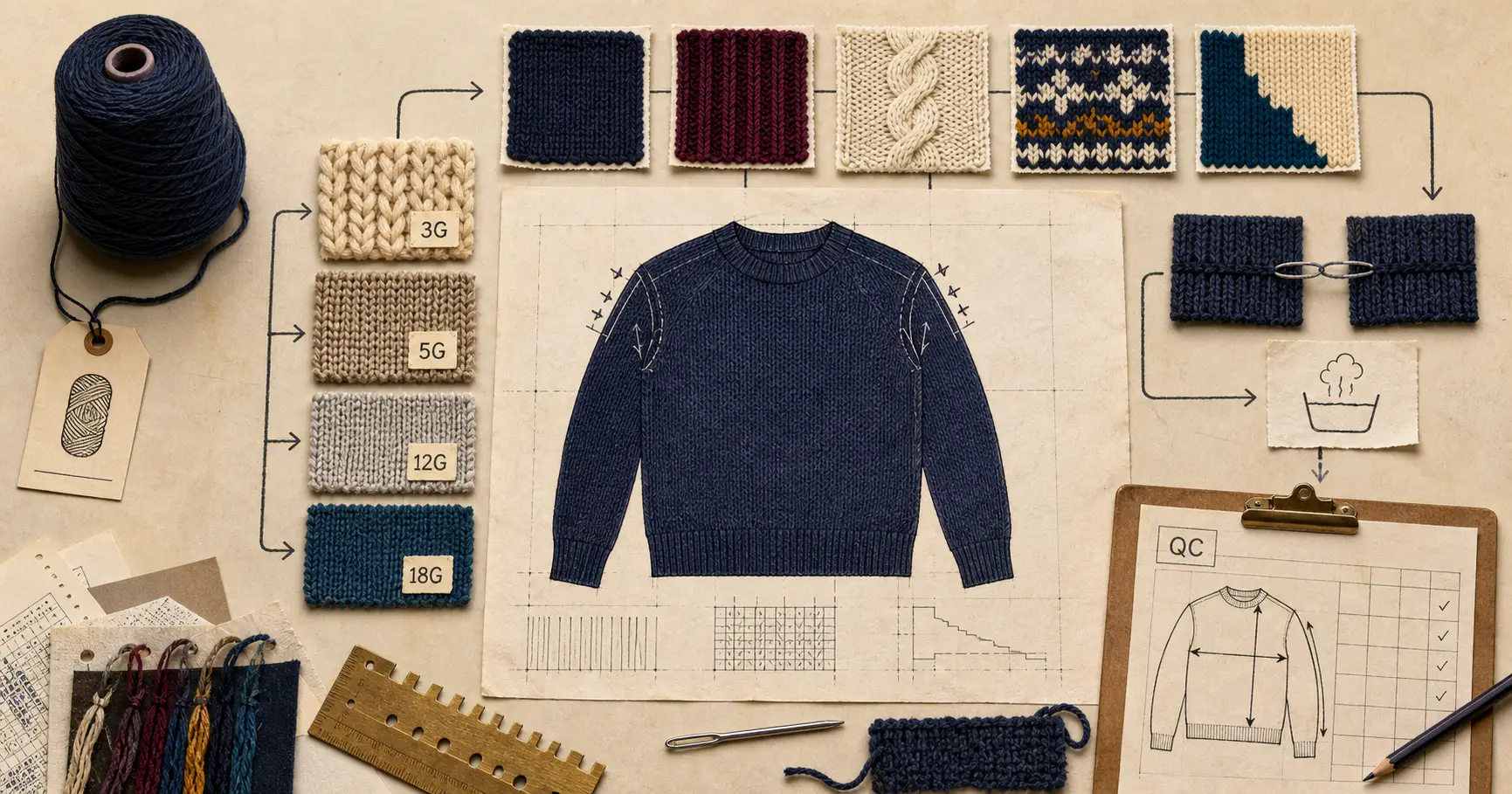
Knitwear stitch types such as jersey, rib, cable, cardigan, pointelle and Milano rib determine texture, stretch, weight, yarn use, knitting time and cost. Gauge from 3GG to 18GG describes machine needle density and fabric scale, but it does not define quality by itself. Jacquard builds repeated or all-over motifs into the knitted structure, while intarsia uses separate yarn carriers for defined colour areas and usually avoids continuous long floats. Buyers should specify yarn count, plies, gauge, stitch length, structure, shaping, artwork method and finishing together, then approve a programmed swatch and washed sample before bulk production.
Key Takeaways
1. Specify the whole fabric system. Knitwear stitch types, yarn count, plies, gauge, stitch length and finishing must be considered together because no single specification defines a sweater’s quality, weight or cost. A 5GG chunky sweater can be as premium as an 18GG fine-gauge pullover when the yarn, density, construction and finishing are appropriate to the product.
2. Match the artwork method to the required product. Jacquard, intarsia and printing can reproduce similar artwork but create fundamentally different knitted products. The correct method depends on artwork layout, reverse appearance, hand feel, colour transitions and production efficiency.
3. Treat construction terms as commercial decisions. Fully fashioned, WHOLEGARMENT, linking, fashion marks, racking and stitch transfer affect material use, machine programming, assembly, fit, seam appearance and development risk. A complete tech pack lets the factory assess feasibility before sampling instead of making assumptions after yarn has been booked.
Table of Contents
- Quick Knitwear Glossary
- Yarn Count and Number of Plies
- What Does Knitting Gauge Mean?
- Gauge Selection by Product Type
- Essential Knitwear Stitch Types
- Jacquard, Intarsia or Printing?
- Shaping Terms
- Fully Fashioned, WHOLEGARMENT and Cut-and-Sew
- Linking and Finishing
- Quality-Control Terms
- Detailed Terms Glossary
- Frequently Asked Questions
- About the Author
- Request a Development Review
Quick Knitwear Glossary
This quick glossary gives designers and buyers a fast reference to the knitwear terms most likely to appear in a tech pack, sample comment or factory quotation. These terms describe how knitted fabric is formed, shaped, assembled and finished. Understanding them helps a buyer ask clearer questions about construction, artwork, fit, quality and production feasibility before a sample or bulk order is approved.
| Term | Quick meaning |
|---|---|
| Course | A horizontal row of knitted loops. |
| Wale | A vertical column of knitted loops. |
| Needle bed | The machine bed that holds and guides needles. |
| Yarn carrier | The device that feeds yarn to working needles. |
| Stitch transfer | Moving a loop between needles or needle beds. |
| Racking | Lateral movement between the front and rear needle beds. |
| Tuck stitch | Holding an existing loop while receiving another yarn feed. |
| Float | Yarn crossing needle positions without forming loops. |
| Fashion marks | Visible shaping lines created by decreases. |
| Sleeve cap | The shaped top section of a set-in sleeve. |
| Pattern matching | Aligning motifs across garment seams. |
| Linking | Joining knitted panels loop by loop. |
| Fulling | Controlled fibre interlocking during wet finishing. |
| Barré | An unintended horizontal variation in knitted fabric. |
| Spirality | Rotation or twisting of a panel or seam after washing. |
Yarn Count and Number of Plies
Yarn count describes yarn fineness, while the number of plies describes how many yarn ends are knitted together. Both must be defined before a factory can assess gauge, weight and cost. Different fibres and spinning systems use different count systems, so a count number should never be evaluated without its unit.
A useful yarn specification includes fibre composition, yarn count and count system, plies, colour reference, yarn supplier and certification requirements. Adding plies generally increases coverage, garment weight and yarn consumption, which is why two sweaters made on the same machine can have very different hand feel and weight.
What Does Knitting Gauge Mean?
Knitting gauge describes the needle density of a knitting machine and helps define fabric scale, not an automatic level of quality. Common computerized flat-knitting gauges include 3GG, 5GG, 7GG, 9GG, 12GG, 14GG, 16GG and 18GG. Lower gauges generally create chunkier and heavier knitwear, while higher gauges work with finer yarns and lighter constructions. Yarn count, plies, stitch length, stitch structure and finishing must still be evaluated together.
Quality boundary: An 18GG sweater is not inherently better than a 5GG sweater. Each gauge serves a different product application and aesthetic direction.
What Is Fine Gauge Knitwear?
Fine gauge knitwear usually uses 16GG or 18GG machines with fine yarns for lightweight, refined products. Typical applications include lightweight merino sweaters, knitted polo shirts, business knitwear and spring cardigans. The gauge can create a clean, fine surface, but it does not independently determine garment weight, opacity, durability or premium quality.
Before approving a fine-gauge design, buyers should test yarn count, ply arrangement, stitch length, structure and finishing on the intended machine, then assess the washed sample for shape retention and hand feel.
What Does Stitch Length Mean?
Stitch length, also called loop length in production, controls how compact or open a knitted fabric becomes at a given yarn and gauge. A shorter stitch length generally creates a tighter and denser structure, while a longer stitch length produces a more open and relaxed fabric. Excessive looseness can reduce stability or create unwanted transparency. Gauge alone is therefore not enough to predict garment weight.
The factory must assess yarn count, plies, stitch length and structure together when programming a sample or comparing two apparently similar fine-gauge sweaters.
Knitting Gauge Selection by Product Type
The correct knitting gauge should be chosen from the intended product, yarn behaviour, target weight, desired hand feel and stitch structure rather than from a trend label alone. This table provides a starting point for product development, not a final technical specification. The same gauge can produce different results when yarn count, plies, loop length, density and finishing change.
Buyers should use the table to brief a factory, then confirm feasibility through a programmed swatch and washed sample before authorizing production.
| Product type | Typical gauge direction | Suitable stitch direction | Development focus |
|---|---|---|---|
| Chunky winter sweater or scarf | 3GG or 5GG | Cable, cardigan stitch, substantial rib | Confirm yarn bulk, garment weight, stitch definition and wash stability. |
| Medium-weight sweater | 7GG or 9GG | Jersey, rib, cable or selected textured structures | Balance coverage, warmth, production speed and intended hand feel. |
| Refined everyday sweater or cardigan | 12GG or 14GG | Jersey, rib, Milano rib, controlled jacquard | Confirm density, pilling risk, measurements and surface consistency. |
| Lightweight merino, polo or spring cardigan | 16GG or 18GG | Fine jersey, fine rib or lightweight pointelle | Check opacity, stitch length, recovery and washed dimensions. |
| Knitted jacket, dress or tailored cardigan | Usually 12GG or 14GG, subject to yarn | Milano rib or other compact, stable structures | Prioritize shape retention, surface stability and limited horizontal stretch. |
| Graphic sweater | Selected after yarn and artwork review | Jacquard, intarsia or printing | Choose by reverse appearance, colour areas, artwork detail and efficiency. |
A Practical Stitch and Gauge Approval Sequence
01
Define the product
Record the product type, target season, weight, hand feel, fit and yarn direction.
02
Select the technical route
Assess yarn count, plies, gauge, stitch structure, shaping and artwork method together.
03
Program and knit a swatch
Check density, scale, reverse appearance, transfers, floats and machine feasibility.
04
Wash and approve the sample
Review dimensions, recovery, hand feel, surface quality and finishing before bulk authorization.
Read the full guide here : Knitwear Tech Pack and RFQ Checklist
Essential Knitwear Stitch Types
Different knitwear stitch types change texture, stretch, weight, yarn consumption, production speed and the amount of technical control required during sampling. The cost levels below are comparative rather than fixed prices because yarn, gauge, density, garment dimensions and colour complexity can change actual manufacturing cost. Choose a construction direction, then ask the factory to validate it with a swatch or development sample.
Jersey Stitch
Definition: Jersey, also called stockinette stitch, has recognizable V-shaped loops on the face and horizontal curved loops on the reverse. Hand feel: Smooth, clean and adaptable, although yarn irregularity, needle marks and tension variation can be more visible than on textured structures. Suitable for: Crew-neck sweaters, cardigans, knitted T-shirts and polo styles. Cost level: Usually the baseline structure for comparison because it is less complex than heavily textured or multi-colour constructions, subject to gauge and yarn.
Rib Stitch
Definition: Rib stitch alternates knit and purl wales to create vertical texture with horizontal stretch. Common versions include 1×1, 2×2 and 2×1 rib. Hand feel: Elastic, textured and close-fitting when correctly specified. Suitable for: Collars, cuffs, hems, plackets and selected full-garment styles. Cost level: Moderate and dependent on width, density and gauge. Buyers should distinguish stretch from recovery because recovery also depends on fibre composition, density and whether elastic yarn is used.
Cable Stitch
Definition: Cable stitch creates raised, rope-like texture by transferring and crossing groups of loops. Hand feel: Dimensional, substantial and visually rich, with a structure that can pull fabric inward. Suitable for: Chunky sweaters, heritage-inspired knitwear and feature panels. Cost level: Higher than basic jersey because cable structures can require additional programming, yarn consumption and knitting time.
Quotation condition: A body panel changed from jersey to all-over cable must be recalculated for width, garment weight and material consumption before the quotation is confirmed.
Cardigan Stitch
Definition: Cardigan stitch uses tuck actions to create a thick, lofty structure. Half-cardigan and full-cardigan are common variations. Hand feel: Warm, substantial and textured, often with more volume than a basic jersey structure. Suitable for: Winter sweaters, scarves and substantial cardigans. Cost level: Generally higher than jersey because these structures usually consume more yarn and knit more slowly.
Sampling should confirm the desired density, finished weight, stretching behaviour and wash result before a buyer uses the structure for a full collection.
Pointelle Stitch
Definition: Pointelle uses transferred loops, increases and decreases to form decorative openings in the knitted structure. Hand feel: Light, decorative and potentially open, depending on hole size, yarn and density. Suitable for: Women’s spring knitwear, lightweight cardigans and knitted dresses. Cost level: Moderate to higher than jersey because transfer operations and openwork placement require technical control.
Buyers should evaluate transparency, structural strength, pattern repeat and vulnerability to snagging during sampling before confirming the final construction.
Milano Rib
Definition: Milano rib is a compact, stable knitwear structure with less horizontal stretch than conventional rib. Hand feel: Structured, clean and tailored rather than highly elastic. Suitable for: Knitted jackets, tailored cardigans, dresses and skirts that need shape retention and a refined surface. Cost level: Moderate, with the final result depending on gauge, yarn, density and garment shape.
It is a useful direction when a designer needs knitwear comfort while avoiding the excessive stretch associated with softer conventional rib structures.
Jacquard, Intarsia or Printing?
Jacquard knitting, intarsia knitting and printing can begin with the same artwork but should be selected as different product constructions, not interchangeable decoration methods. Jacquard uses selected needles and coloured yarns to build a motif into the fabric. Intarsia uses separate yarn carriers for individual colour areas. Printing applies artwork after the panel or garment has been knitted.
Buyers should decide based on the desired reverse appearance, artwork scale, number and arrangement of colours, hand feel, garment weight and the type of production efficiency required.
| Method | Best suited to | Reverse appearance | Primary cost and feasibility driver |
|---|---|---|---|
| Jacquard knitting | Repeated patterns, all-over graphics, logos, geometric motifs, animal patterns and holiday sweaters | May have floats on the reverse or a second knitted layer, depending on construction | Working colours per course, colour-change frequency and backing structure can matter more than total artwork colours. |
| Intarsia knitting | Large letters, bold geometric blocks, character motifs and oversized logos | Usually avoids continuous long floats across the full reverse | Separate colour areas, yarn-carrier planning and transitions determine complexity. Three colours can still be difficult when divided into many disconnected areas. |
| Printing | Photographic images, gradients, fine illustrations and artwork with many colours | Usually no yarn-built pattern on the reverse | Colour reproduction and print suitability should be assessed after the fabric and surface finish are selected. |
Artwork requirement: The factory should receive editable artwork, target dimensions, placement instructions, colour references and a clear statement of whether the reverse must remain clean, fully backed or visually consistent with the face.
Shaping Terms: Increases, Decreases and Armholes
Unlike many cut-and-sew garments, knitted panels can be shaped while they are being produced through increases, decreases and loop transfers. Increasing adds loops to make a panel wider, while decreasing, also called narrowing, removes loops to make it narrower. These actions are used around necklines, armholes, shoulders, sleeves, waists and skirt shapes. Visible decrease lines are often called fashion marks and can be structural as well as decorative.
The shape must be evaluated with the full fit system, not as an isolated drawing instruction.
What Is Armhole Shaping?
Armhole shaping describes the area from the underarm to the shoulder, including its depth, curve and narrowing sequence. An armhole that is too shallow can restrict movement, while an armhole that is too deep can create excess fabric under the arm. The specification should therefore be reviewed together with chest width, shoulder width, sleeve-cap shape and physical fitting.
Raglan sleeves extend from the underarm toward the neckline, set-in sleeves use a shaped sleeve cap in the body armhole, and drop shoulders extend beyond the natural shoulder point for a relaxed silhouette.
Fully Fashioned, WHOLEGARMENT and Cut-and-Sew Knitwear
Fully fashioned knitwear, WHOLEGARMENT knitting and cut-and-sew knitwear describe different ways of forming and assembling a garment, each with different development and production implications. Fully fashioned panels are shaped during knitting through increases, decreases and loop transfers, then assembled through knitwear linking. WHOLEGARMENT knitting produces a garment much closer to its finished three-dimensional form and can reduce selected sewing and linking operations.
Cut-and-sew knitwear starts from a larger knitted fabric or panel that is cut to shape and sewn, which can suit certain systems but generally creates more cutting waste.
What Is Fully Fashioned Knitwear?
Fully fashioned knitwear is shaped during knitting rather than cut from a larger knitted fabric. The front, back and sleeves are knitted close to their intended shapes using increases, decreases and loop transfers. Separate panels are then assembled, usually by knitwear linking. This method can reduce cutting waste and create clean fashion marks around armholes, shoulders and necklines.
Feasibility still depends on yarn, gauge, size range, pattern making, stitch structure and finishing, so buyers should approve a complete sample before confirming bulk production.
What Is WHOLEGARMENT Knitting?
WHOLEGARMENT knitting produces a garment closer to its finished three-dimensional form, reducing selected sewing and linking operations. It is not automatically suitable for every yarn, design or product category. Feasibility depends on machine configuration, yarn performance, size range, pattern, programming requirements and the desired fit. Buyers should consider it as a construction option rather than a universal quality upgrade.
Technical reference : SHIMA SEIKI WHOLEGARMENT Official Resource
Knitwear Linking and Finishing
A knitted panel leaving the machine is not yet a finished sweater. Linking, pattern matching and wet finishing determine whether the garment achieves its intended fit, appearance and hand feel. Linking joins corresponding loops and is commonly used at shoulders, armholes, side seams, necklines and plackets. It can create flatter and more elastic seams than basic sewing when loop alignment and tension are correct.
Striped, checked and continuous jacquard designs may also require pattern matching across seams, which should be specified before sampling because it can increase yarn use and production time.
What Does Knitwear Washing Finishing Include?
Knitwear washing finishing may include washing, softening, fulling, brushing, drying, steam blocking, pressing and final measurement checks. The same yarn and stitch can produce different results under different washing conditions. Water temperature, cycle time, mechanical action, softener and drying method can all influence the finished garment’s dimensions, surface character and hand feel. The approved sample should therefore be assessed after final finishing, not merely after knitting.
Buyers should state the required hand feel and performance expectations before sampling so the factory can plan the correct finishing route.
Knitwear Quality-Control Terms
A professional knitwear quality-control process evaluates physical performance, measurements, colour behaviour, surface appearance and finishing consistency rather than relying only on visual inspection. Pilling, shrinkage, colour fastness and snagging are common technical concerns because knitted loops and yarn surfaces respond differently to rubbing, washing, moisture and use. The required test method, acceptance level and inspection scope should be agreed before production.
Chemical safety is separate from physical performance, so buyers should also clarify whether harmful-substance testing or a valid material certificate is required for the intended product and market.
- Pilling: Loose surface fibres become entangled through rubbing. Fibre length, yarn construction, density and finishing affect performance. ISO 12945-2:2020 describes a modified Martindale method.
- Shrinkage and dimensional change: Knitted loops and fibres may relax or contract during washing, so length and width should be measured separately. ISO 5077:2007 describes a measurement method after washing and drying.
- Colour fastness: This evaluates fading or colour transfer during washing, rubbing, perspiration, water exposure or light exposure. Dark-and-light jacquard and intarsia need particular attention.
- Snagging: A yarn or loop is pulled by an external object. Open structures, long floats and some fine yarns can be more vulnerable.
Compliance note: For harmful-substance testing references, consult OEKO-TEX STANDARD 100 and verify the scope and validity relevant to the actual material or product.
Detailed Knitwear Terms Glossary
These definitions explain the production vocabulary that appears most often in knitwear development discussions between designers, buyers, technicians and factories. A term is most useful when it is connected to a decision. For example, a float affects reverse appearance and snagging risk, while a stitch transfer can affect shaping, pointelle detail, cable construction or fashion marks.
| Term | Working definition |
|---|---|
| Course | A horizontal row of knitted loops. Course direction is useful when describing stripe placement, jacquard colour changes and fabric density. |
| Wale | A vertical column of knitted loops. Rib structures are often described by their alternating wale arrangement, such as 1×1 or 2×2 rib. |
| Needle bed | The machine bed that holds and guides needles. Flat-knitting machines may use front and rear needle beds for structures, transfers and racking. |
| Yarn carrier | The device that feeds yarn to working needles. Carrier planning is especially important in intarsia and multi-colour knitwear. |
| Stitch transfer | Moving a loop between needles or needle beds. Transfers are used for shaping, pointelle, cables and other engineered structures. |
| Racking | Lateral movement between front and rear needle beds. It supports selected structures, alignment and transfer-based technical details. |
| Tuck stitch | Holding an existing loop while receiving another yarn feed. Tuck actions are used in structures such as cardigan stitch to create texture and volume. |
| Float | Yarn crossing needle positions without forming loops. Floats may appear on the reverse of some jacquard constructions and require product-specific review. |
| Fashion marks | Visible shaping lines created by decreases. They can be decorative features as well as evidence of shaped knitting around armholes, shoulders or necklines. |
| Sleeve cap | The shaped upper section of a set-in sleeve that joins the body armhole. Its shape influences shoulder appearance, arm movement and fit. |
| Pattern matching | Aligning stripes, checks or motifs across garment seams. It should be specified before sampling because it can affect material use and production time. |
| Linking | Joining knitted panels loop by loop. Correct linking supports flat seams, elasticity, symmetry and a refined finished appearance. |
| Fulling | Controlled fibre interlocking during wet finishing. It can change density, surface character, dimensions and hand feel. |
| Barré | An unintended horizontal variation in knitted fabric. It can be caused by yarn, tension, machine or process inconsistency and should be reviewed during inspection. |
| Spirality | Rotation or twisting of a panel or seam after washing. It should be evaluated after finishing because moisture, mechanical action and drying can reveal the effect. |
Frequently Asked Questions
These answers address the stitch, gauge and construction decisions that most often create misunderstandings during knitwear product development. A single label such as 18GG, jacquard or fully fashioned does not define the finished product by itself. Buyers should give the factory enough information to assess yarn, density, stitch structure, shaping, artwork method, finishing and quality expectations together.
A programmed swatch and washed sample remain the most reliable way to validate the final result before bulk production.
Is 18GG Better Quality Than 12GG Knitwear?
No. The numbers describe knitting gauge, not overall quality. An 18GG machine is generally used for finer yarns and lighter fabrics, while 12GG knitwear often suits refined mid-fine sweaters and cardigans. A well-made 5GG chunky sweater can also be premium when the yarn, density, construction and finishing are appropriate.
Select gauge from the intended product, garment weight, hand feel and yarn behaviour, then evaluate a washed sample for surface quality, dimensions and performance.
Is Jacquard Knitting More Expensive Than Intarsia Knitting?
Not always. Jacquard cost depends on the number of working colours within the same course, colour-change frequency and backing structure. Intarsia cost depends on the number of yarn carriers, separate colour areas and transitions. A design with only three colours can still be difficult in intarsia when those colours are divided into many small disconnected areas.
The artwork, repeat, reverse appearance, yarn choice and construction should be reviewed before either method is priced, sampled or selected as the final production route.
Is Fully Fashioned Knitwear the Same as WHOLEGARMENT Knitting?
No. Fully fashioned knitwear normally consists of shaped front, back and sleeve panels produced close to their required shapes, then assembled through linking. WHOLEGARMENT knitting creates a garment closer to its finished three-dimensional form and can reduce selected assembly operations.
Both methods require technical assessment of yarn, machine capability, size range, pattern, programming and fit. The correct choice depends on the design and production target.
Why Do Sweater Measurements Change After Washing?
Knitted loops and fibres can relax, swell or contract in response to moisture, temperature, mechanical action and drying. The same yarn and stitch may therefore produce different dimensions before and after finishing. Factories should measure length and width separately after the relevant wash process, then adjust knitting specifications during development when necessary.
Buyers should approve the final sample after washing, steaming and pressing because an unwashed panel does not represent the finished garment or the bulk-production benchmark.
What Should a Designer Include When Requesting a Stitch or Gauge Recommendation?
A useful request includes the target fibre composition, yarn direction or available yarn, product type, target season, intended garment weight, reference images, desired hand feel, artwork, approximate quantity, colour count and delivery target. The factory can then assess suitable gauge, stitch structure, construction method and finishing route.
For a complete development brief, use a clear knitwear tech pack and RFQ checklist before requesting a production quotation.
How Can Buyers Apply Stitch and Gauge Knowledge to A/W 2027?
After choosing between cable, jacquard, intarsia, fully fashioned and fine-gauge construction, the next step is to connect each technical decision with yarn, colour, cost level and development timing. The related sourcing guide translates three commercial A/W directions—3D texture, earth tones and quiet luxury—into practical specifications and a backward A/W 2027 development calendar.
Read the full guide here : Knitwear Trends 2026: A/W 2027 Sourcing Guide
Request a Knitwear Development Review
If your team needs help choosing between jersey, rib, cable, pointelle, Milano rib, jacquard, intarsia, fine-gauge or fully fashioned construction, prepare the artwork, tech pack, target yarn, gauge direction and estimated order quantity. A structured review can identify decisions affecting yarn consumption, machine feasibility, reverse appearance, fit, finishing and commercial cost before sample development begins.
YouTricot can review the development brief and identify the technical questions that should be resolved before sampling.
Read the full guide here : China Knitwear OEM Sourcing Guide