

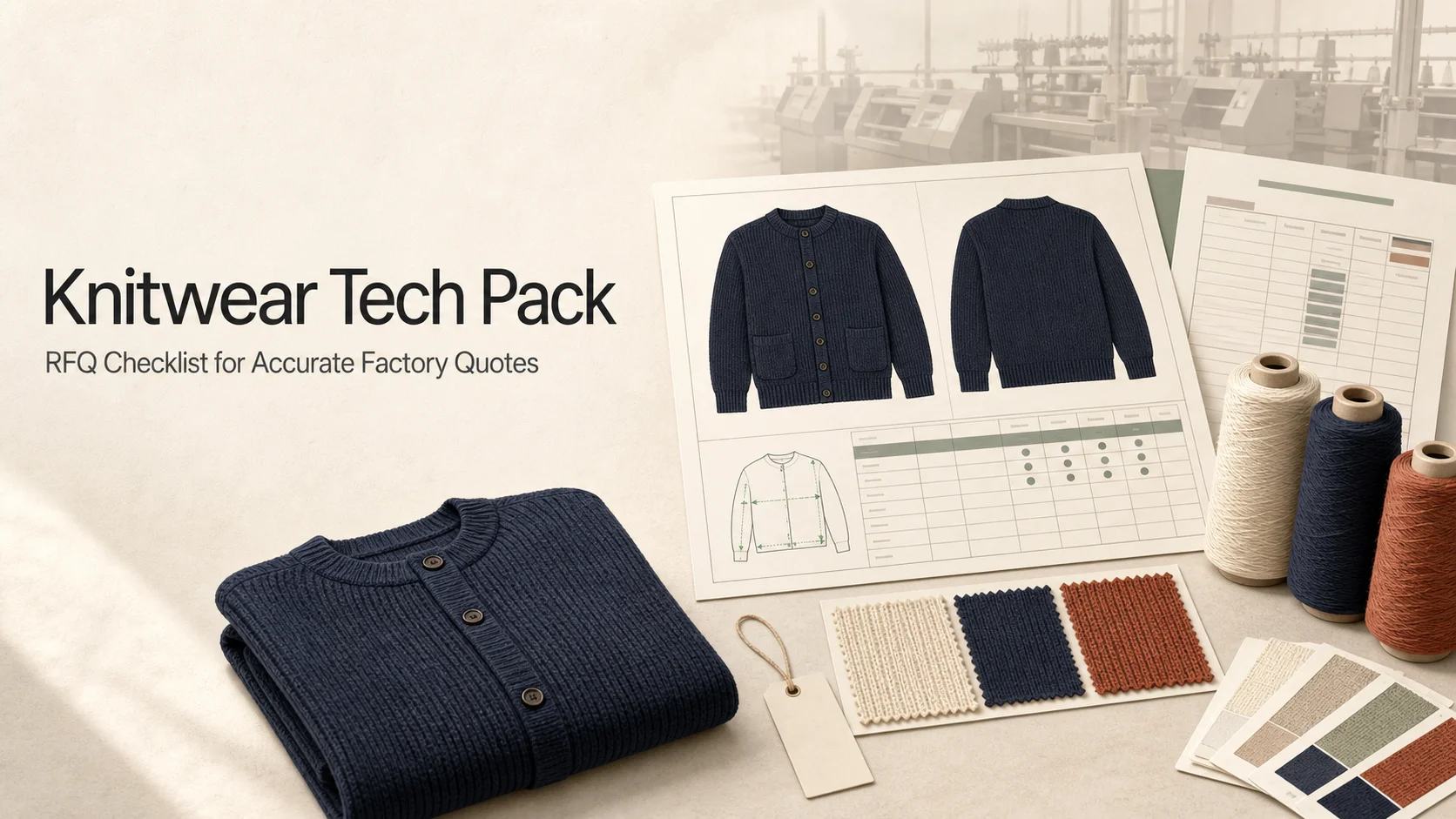
Quick Answer: A quote-ready knitwear tech pack should define the technical flats, yarn direction, gauge, stitch structure, measurements, tolerances, artwork, BOM, packaging and testing requirements. Send it with an RFQ cover sheet stating quantities, sample type, delivery date, destination and Incoterms. For YouTricot, plan 50 pieces per style per color. Label unresolved choices “factory to recommend” and identify the approver so every supplier prices the same technical and commercial scope.
A knitwear tech pack defines what the garment should become, while the RFQ defines what the manufacturer must price and under which commercial conditions. Sending both documents together reduces hidden assumptions and gives buyers a clearer basis for comparing factory quotations.
This guide explains how to submit a tech pack to a knitwear factory without leaving critical yarn, construction, quality or delivery decisions open to interpretation. The objective is not to make the document unnecessarily long. It is to make every assumption that can affect feasibility, fit, performance, unit cost or lead time visible before development begins.
Key Takeaways
1. Define the product and quotation conditions together. Technical flats, yarn direction, gauge, stitch structure, measurements, tolerances, artwork, trims, packaging and testing requirements explain what the factory must make. The RFQ adds quantities, sample expectations, delivery dates, destination and Incoterms.
2. Remove ambiguity instead of adding unnecessary pages. Give every style a number, version and revision date. Use measurable points of measure, identify color and artwork standards, and label undecided items “factory to recommend.” The factory should not have to guess which file is current or whether packaging is included.
3. Include specifications unique to knitted garments. Yarn count, hand feel, machine gauge, stitch density, panel construction, needle reductions, linking, washing and finishing can affect feasibility, appearance, unit cost and lead time. Writing only “12GG sweater” is not enough.
4. Compare quotations against one approved scope. Yarn, construction, quantity, testing, trims, sample rounds and trade terms must match. For YouTricot projects, the MOQ is 50 pieces per style per color. Confirm inclusions, exclusions, lead-time triggers and possible cost changes before sampling.
Table of Contents
The 60-Second Knitwear RFQ Checklist
A factory can usually identify whether an RFQ is quote-ready in about one minute by checking whether the product, quantity, quality standard and commercial terms are defined. Copy the checklist below into an email, project brief or sourcing system before sending the files.
If a point has not been decided, write “factory to recommend” and name the person responsible for approval. Do not leave a blank that could be interpreted differently by each supplier.
- ☐ Style name, style code, season, version number and revision date
- ☐ Front, back, side and construction-detail technical flats
- ☐ Yarn composition, yarn count or required hand-feel direction
- ☐ Machine gauge, stitch structure, density and construction method
- ☐ Base size, points of measure, grading rules and tolerances
- ☐ Pantone references, colorways, artwork and placement instructions
- ☐ Bill of materials, labels, trims and packaging requirements
- ☐ Testing, inspection, compliance and approval expectations
- ☐ Quantity by style, color and size, based on 50 pieces per style per color
- ☐ Sample deadline, bulk delivery date, destination and Incoterms
What Is the Difference Between a Knitwear Tech Pack and an RFQ?
A knitwear tech pack answers “What are we making?” An RFQ answers “What exactly should be quoted?” A sample brief records what must be evaluated during product development. These documents should travel together because a technically detailed garment without quantity and delivery information cannot be priced accurately.
A commercial inquiry without construction details creates the opposite problem: the manufacturer must make assumptions about yarn, gauge, measurements, finishing and quality. Those assumptions can make two quotations look comparable when they are pricing technically different sweaters.
| Document | Main Purpose | Typical Contents |
|---|---|---|
| Tech pack | Defines the finished garment | Construction, yarn, measurements, colors, artwork, trims and labels |
| RFQ | Defines the quotation scope | Quantity, target dates, sample requirements, destination and trade terms |
| Sample brief | Defines development approval | Fit comments, hand-feel targets, technical risks and approval criteria |
What Should a Quote-Ready Knitwear Tech Pack Include?
A quote-ready knitwear tech pack contains ten connected information groups. Together, they allow a factory to evaluate design feasibility, material consumption, machine requirements, labor, quality controls and commercial timing.
Each group should be specific enough to support a quotation while clearly identifying decisions that remain open. The aim is not to create paperwork for its own sake. It is to make every assumption affecting cost, fit, performance or delivery visible before the buyer compares suppliers or pays for development.
1. What Identification Details Belong in a Knitwear Tech Pack?
Give every style a unique name, internal style number, season, version number, revision date and status. For example: Women’s Crewneck Cardigan; WT-SS26-014; V03; 30 July 2026; RFQ. Change the status when the file moves into development or bulk revision.
Version control prevents a factory from quoting one file while producing a sample from another. If an item remains undecided, write “factory to recommend” and identify who will approve the final choice.
Open-decision rule: Identify the open decision, request a recommendation and name the person responsible for approving it. Do not leave an unexplained blank.
2. Use Technical Flats, Not Only Reference Images
Provide clean front and back technical flats, plus side views and close-ups wherever construction could be misunderstood. Show the neckline, rib widths, shoulder construction, sleeve and cuff shape, hem, placket, pocket, slit, openings, logos, labels and all stitch or color changes.
Mood images can communicate direction but cannot define a production-ready sweater. A factory must see the garment as a construction problem, with placement and assembly instructions, rather than interpret a lifestyle photograph as a complete specification.
3. Define the Yarn and Intended Hand Feel
Specify the fiber composition, preferred yarn count or mill, color method, target hand feel and any certification or traceability requirements. Useful hand-feel terms include dry, crisp, soft, lofty, compact and brushed.
State whether the yarn will be yarn-dyed, piece-dyed or mélange and whether recycled or certified material is required. If the exact yarn remains undecided, define the required performance, season and price position. Ask the factory to recommend two or three separately priced options instead of guessing a yarn count.
4. How Should a Knitwear Tech Pack Specify Gauge, Stitch and Construction?
Record the machine gauge, main stitch structure, density direction and panel construction because gauge alone does not define a sweater. Relevant gauges may include 3GG, 5GG, 7GG, 12GG or 14GG. Structures may include jersey, rib, cable, pointelle, Milano rib, jacquard or intarsia.
State whether panels are fully fashioned, cut-and-sewn or knit-to-shape. Add needle reduction positions, rib dimensions, finishing instructions and editable repeat artwork when jacquard or intarsia placement must be controlled.
5. Make Measurements and Tolerances Measurable
Support every technical flat with a measurement specification containing a base size, points of measure, finished dimensions, tolerances and grading rules. Define the exact start and end points for body length, chest width, sleeves, ribs and openings.
For fitted styles, cardigan plackets, rib hems and high-stretch cuffs, state whether the measurement is taken relaxed, stretched or after washing. Without a shared measuring method, two factories can appear to quote the same garment while using different fit assumptions.
6. Attach Color, Artwork and Branding Details
Use Pantone references, lab dips, approved swatches or physical standards rather than treating a screen color as a production standard. For every colorway, identify the main body color, contrast yarn, stripe sequence, jacquard placement, artwork size and logo location.
State whether color approval is required before sampling or bulk yarn booking. Include editable artwork for jacquard, intarsia, embroidery and labels wherever possible, together with instructions for main labels, care labels, size labels, hangtags, badges and country-of-origin marking.
7. Include the BOM, Packaging and Market Requirements
The bill of materials should list every visible or mandatory component that may affect sourcing, labor or cost. Include main and contrast yarns, buttons, zippers, snaps, drawcords, woven or printed labels, care labels, hangtags, barcodes, polybags, tissue, folding boards and carton marks.
State whether garments must be folded, hung, individually bagged, ticketed or packed in retailer-ready cartons. For international sales, identify fiber-content, care-label, origin and market requirements before the quotation is finalized.
8. Which Testing Requirements Belong in a Knitwear Tech Pack?
Replace vague requests for “good quality” with test methods, acceptance criteria and an agreed inspection approach. Depending on the product and market, the RFQ may cover pilling, dimensional change, color fastness, appearance after washing, restricted substances, defect classification and AQL.
Relevant test references:
- ISO 12945-2:2020 — modified Martindale testing for pilling, fuzzing and matting
- ISO 5077:2007 — dimensional change in washing and drying
- ISO 105-C06:2010 — color fastness to domestic and commercial laundering
- ISO 2859-1:2026 — sampling schemes indexed by acceptance quality limit for lot-by-lot inspection
AQL is not the same as zero defects. Buyers should define inspection levels, defect categories and acceptance limits instead of requesting an “AQL inspection” without an agreed sampling plan and quality standard.
9. Show Quantity by Style, Color and Size
Provide the quantity split by style, color and size because a total order quantity does not reveal the production structure. For YouTricot custom knitwear, the MOQ is 50 pieces per style per color. The size ratio can be divided within each qualifying style-and-color quantity.
Commercial limitation: Yarn-mill minimums, custom dyeing, unusual trims, complex sampling and very small size splits can still affect yarn selection, feasibility, unit cost or scheduling. Record these effects as priced assumptions or exclusions without replacing the stated MOQ of 50 pieces per style per color.
Ask the supplier to show the cost effect of alternative quantity levels, especially for a first launch. A lower unit price at a much higher order quantity may increase inventory exposure and should not automatically be treated as the better commercial option.
| Color | XS | S | M | L | XL | Total |
|---|---|---|---|---|---|---|
| Navy | 80 | 160 | 220 | 140 | 60 | 660 |
| Oatmeal | 60 | 120 | 180 | 120 | 40 | 520 |
| Total | 140 | 280 | 400 | 260 | 100 | 1,180 |
10. Clarify Sampling, Lead Time and Trade Terms
State the required sample type, sample deadline, bulk delivery window, destination, Incoterms and any material-booking approval. Identify whether the request is for a proto, fit, salesman, pre-production or size-set sample. Separate sample charges, development time and bulk lead time rather than accepting one vague schedule.
Complex knitwear sample development may involve programming, custom yarn, pattern making, needle drafting, hand linking, washing trials or color approvals. For YouTricot projects, the symbolic sampling fee is fully deductible from later bulk production orders. Sampling should not be represented as completely free.
Five Mistakes That Make Knitwear Quotes Less Reliable
The most damaging RFQ mistakes allow each supplier to price a different interpretation of the same style. Buyers can prevent most of these problems by checking the brief for missing technical decisions, unmatched quantities and undefined quality requirements before sending it.
- Using reference images as the only brief: Photographs do not define yarn, gauge, fabric weight, construction, dimensions or tolerances.
- Leaving unresolved details unmarked: Label open decisions clearly, request options and identify who will approve them.
- Asking for one unexplained “all-in” price: Request clarity on yarn, knitting, linking, washing, trims, packaging, testing and sample costs.
- Comparing prices with different quantity structures: Use the same color and size breakdown, based on 50 pieces per style per color, for every quotation.
- Waiting until bulk production to define quality: Testing, inspection, label and compliance expectations should be agreed before yarn booking.
Correcting ambiguity at the RFQ stage is usually easier than reconciling incomparable quotations or renegotiating costs after yarn booking. A controlled RFQ also protects the approved scope when a supplier proposes technical or commercial changes.
How Should You Send an RFQ Package to a Knitwear Factory?
Send one clearly versioned RFQ package with a predictable folder structure. Use one PDF for the main tech pack, an editable measurement sheet, a dedicated artwork folder, an RFQ cover sheet and a separate reference-image folder.
The filename should include the style number, product name, version and date. Avoid sending several competing attachments across different email threads.
- 01_Tech_Pack.pdf — technical flats, construction notes, measurements and BOM
- 02_Measurement_Spec.xlsx — editable size chart, grading and tolerances
- 03_Artwork — AI, PDF or high-resolution jacquard, embroidery and label files
- 04_RFQ_Cover_Sheet.pdf — quantities, timeline, destination and trade terms
- 05_Reference_Images — supporting visual direction, not production instructions
Recommended filename:
WT-SS26-014_Cardigan_V03_2026-07-30.pdf
Avoid names such as “final_final_new2.pdf,” which do not show which document has authority.
Read the full guide here : knitwear stitch types glossary
What Happens After You Submit the Tech Pack?
A capable factory should review technical and commercial risks before issuing a final quotation or starting a sample. The review should identify missing information, unsuitable construction, yarn alternatives, approval dependencies and whether the quantity plan meets the MOQ of 50 pieces per style per color.
The buyer then resolves those points before the factory commits material or machine time. A disciplined workflow does not eliminate communication. It ensures that every approval addresses the correct risk before the next financial commitment is made.
01
Factory reviews feasibility and missing information.
02
Buyer confirms yarn, construction and quantity options.
03
Factory provides the quotation and sampling proposal.
04
Development sample is produced and reviewed.
05
Fit, hand feel, color and workmanship are revised.
06
Pre-production sample is approved.
07
Bulk production, inspection and shipment follow.
Frequently Asked Questions
Preliminary estimates can be produced from limited information, but reliable supplier comparisons require the same technical and commercial scope. Record every assumption and compare quotations only after yarn, construction, quantity, quality requirements and delivery terms have been aligned.
Can a Factory Quote from a Sketch Instead of a Full Tech Pack?
Yes, but the result will normally be a preliminary estimate rather than a quotation suitable for final supplier comparison. The factory must assume yarn, gauge, stitch density, measurements, construction and finishing, and another supplier may make different assumptions. Before sampling or supplier selection, replace those assumptions with technical flats, measurements, yarn direction, quantities, quality requirements and commercial terms.
Do I Need to Specify the Exact Yarn Before Requesting a Quote?
Not always. If the yarn has not been selected, specify the required fiber composition, hand feel, season, target price level, color direction and any certification or traceability requirements. Ask the factory to propose two or three yarn options and quote each separately. The quotation should show whether yarn availability, mill minimums, custom dyeing or color booking could affect material choice, price, sampling or bulk-production timing.
Is “12GG” Enough Information for a Sweater Quotation?
No. Machine gauge must be considered together with yarn count, stitch structure, density, panel construction, garment weight and finishing. Two 12GG sweaters may have different yarn consumption, knitting time, hand feel and appearance. A quote-ready specification should identify the target yarn, structure, fabric reference and finished result.
What Is the MOQ for Custom Knitwear at YouTricot?
The MOQ is 50 pieces per style per color. The size ratio can be divided within that style-and-color quantity. Custom yarn, special dye lots, complex artwork or unusual trims may still affect feasibility, material choice, price or scheduling, so these requirements should be shown in the RFQ.
Do Sweater Factories Offer Sampling Services?
Yes. Knitwear factories may develop proto, fit, salesman, pre-production and size-set samples, depending on the project stage. The sampling brief should define the sample type, yarn, construction, measurements, approval criteria and included revision rounds. At YouTricot, the symbolic sampling fee is fully deductible from later bulk production orders.
Why Can Knitwear Sample Fees Vary Between Suppliers?
Development may require programming, yarn sourcing, pattern making, needle drafting, hand linking, washing trials, custom trims, labels and more than one revision. Ask which activities and revision rounds are included, whether testing or courier charges are separate and how additional changes are approved. For YouTricot projects, the sampling fee is symbolic and fully deductible from later bulk production orders rather than represented as completely free.
Buyer Toolkit: Quote Comparison and RFQ Email
Use the same quotation comparison questions and email request for every shortlisted supplier so differences in yarn, workmanship, quantity, testing and commercial terms remain visible. Record “not included,” “to be confirmed” or “factory recommendation” wherever a quotation still carries unresolved cost or delivery risk.
Store the completed comparison with the relevant RFQ version, quotation date and supplier response. This creates a documented basis for later sampling, negotiation and production decisions.
Factory Quote Comparison Checklist
| Quote Item | Question to Ask When Comparing Suppliers |
|---|---|
| Yarn | Are the fiber composition, yarn source, yarn count, color method and cost basis equivalent? |
| Gauge and stitch | Are the machine gauge, stitch structure, density and panel construction based on the same specification? |
| Make-up | Does the quotation include linking, washing, pressing, finishing and final garment inspection? |
| Trims | Are labels, buttons, hangtags, packaging materials and retailer-specific requirements included? |
| Testing | Which tests, methods, inspection stages and additional laboratory charges are included? |
| Samples | Which sample type and revision rounds are included, what does the symbolic sampling fee cover, and is it fully deductible from later bulk production orders? |
| MOQ | Does the quotation apply the MOQ of 50 pieces per style per color to the requested color and size breakdown? |
| Lead time | What triggers the sample and bulk lead times, and which buyer approvals could change the schedule? |
| Shipping terms | Is the quotation based on EXW, FOB, CIF or DDP, and which freight or customs costs remain excluded? |
| Exclusions | Which costs, services, materials or approval changes could be added after the quotation is issued? |
A headline unit price is not comparable when another quotation includes different yarn, washing, linking, testing, packaging, sample rounds or shipping terms. Compare the total production scope, not only the lowest visible number.
Quotation comparison resources: Access additional sourcing whitepapers through the SlideShare Knitwear Whitepaper Library. Select the document that matches your sourcing stage and confirm its scope before using it to evaluate suppliers.
Read the full guide here : China knitwear OEM sourcing guide
Copy-and-Use RFQ Email Template
Subject: RFQ Request — [Style Name / Style Number]
Hello [Factory Contact],
Please find attached our RFQ package for [Style Name / Style Number]. The package includes:
- Tech pack and technical flats
- Measurement specification
- Yarn, gauge and stitch requirements
- Color and artwork references
- BOM, labels and packaging requirements
- Testing and inspection expectations
- Quantity breakdown, sample timeline and delivery target
Please confirm:
- Feasibility and recommended construction changes, if any
- MOQ of 50 pieces per style per color
- Symbolic sampling fee, included development work and confirmation that the fee is fully deductible from later bulk production orders
- Bulk unit price at the requested quantities
- Bulk production lead time after approval
- Quotation terms and any exclusions
- Any missing information needed for an accurate quote
Please quote against the attached version only: [Version Number / Date].
Best regards,
[Name]
[Company]
About the Author
Frank, Founder of YouTricot
Frank has 20 years of knitwear industry and operational experience across Prato, Italy and Dalang, Dongguan, China. YouTricot operates 120 Shima Seiki and 80 Stoll computerized flat knitting machines covering gauges from 3G to 18G. The 80 upgraded Stoll machines added in May 2026 include 50 machines in 12 gauge and 30 machines in 7 gauge. YouTricot specializes in cashmere, merino wool and silk-blend knitwear for EU and US fashion brands.
Request a Knitwear Tech Pack and RFQ Review
Submit one current tech pack, measurement sheet, artwork package, quantity breakdown and target delivery date. A technical review can identify missing production information, unresolved yarn or construction choices, unclear measurement methods and commercial assumptions before sampling begins.
Do you need OEM, ODM or a hybrid development model?
Read the full guide here : OEM vs ODM knitwear decision guide